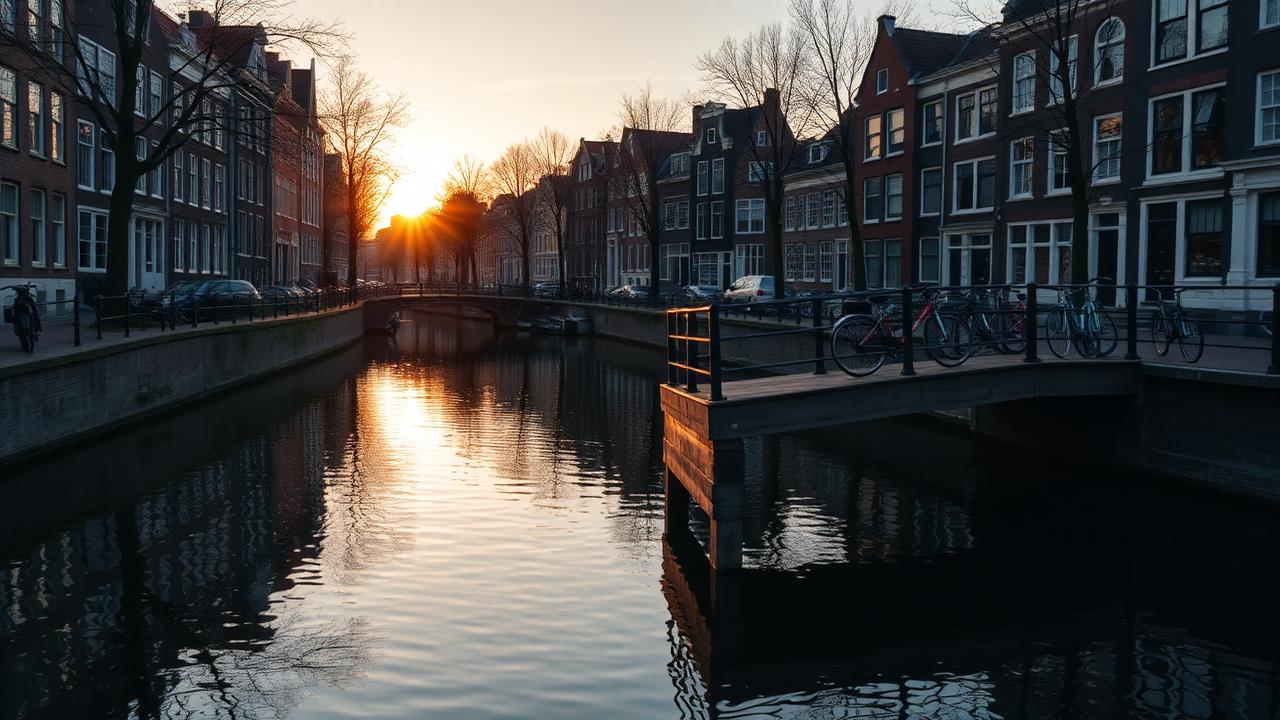
The Netherlands: Where Directness Is a Feature, Not a Bug
The Dutch will tell you exactly what they think about your salary negotiation, your contract terms, and your apartment hunting strategy — usually before you''ve even asked. It takes some getting used to. But once you do, you realise this directness extends to the entire system. The Netherlands is one of the most transparent, well-organised countries in Europe to work in. Once you know the rules.
I moved here thinking it would be just another EU country with bikes and canals. Six months in, I realised the Dutch had quietly built one of the best places in Europe to be a working professional — if you understand how the machine works. Most expats don''t. They sign a contract, miss the 30% ruling deadline, never apply for zorgtoeslag, and wonder why their Belgian friends seem to have it easier.
Here''s the honest version. The one nobody tells you at the welcome drinks.
People move to the Netherlands for work because the country is one of Europe''s biggest international hubs. Shell, Philips, ASML, Heineken, ING, Booking.com, IKEA Europe — they''re all headquartered here. Amsterdam, Rotterdam, The Hague and Eindhoven each have their own strong job markets — Amsterdam for finance and tech, Rotterdam for logistics and engineering, The Hague for international institutions, Eindhoven for hardware and chip design (ASML is twenty minutes away).
English is essentially a second official language in the business world. You can land at Schiphol on Monday and start work on Tuesday without speaking a word of Dutch. Salaries are high, especially in tech, finance, engineering and logistics. Worker protections are among the strongest in the EU. And the 30% ruling — the famous tax break for qualifying expats — can save you the price of a small car every year.
Sound too good? It''s not. But there are rules. Lots of them. Let''s go through them.
What Your Dutch Salary Actually Looks Like
The Dutch tax system is different from most of Europe and worth understanding properly. It uses a "box" system with three separate boxes:
- Box 1: income from employment and home ownership — taxed progressively at 35.75% to 49.5%
- Box 2: income from substantial shareholdings (5%+ stake in a company) — flat 24.5% up to €68,843, then 31% above
- Box 3: income from savings and investments — a wealth tax on deemed returns above the €59,357 tax-free threshold
For most employees, only Box 1 matters. Forget the others until you''re buying shares in your own startup.
The 2026 Box 1 brackets
- 35.75% on income up to €38,883
- 37.56% on income from €38,883 to €78,426
- 49.50% on income above €78,426
Now here''s the thing nobody explains clearly: that 35.75% in the first bracket is mostly social security. About 27.65 percentage points of it go to AOW (state pension), Anw (surviving relatives) and Wlz (long-term care). The actual income tax part of bracket 1 is only around 8.1%. That''s why your effective tax rate isn''t as brutal as the headline numbers suggest.
Two tax credits also pull your bill down significantly:
- Algemene heffingskorting (general tax credit): up to €3,115 in 2026, phasing out above €29,736
- Arbeidskorting (employment tax credit): up to €5,685 in 2026, phasing out above €45,592
Real net salary examples (single worker, no 30% ruling, 2026)
- €35,000 gross/year → approximately €2,050–2,100 net/month
- €45,000 gross/year → approximately €2,500–2,600 net/month
- €55,000 gross/year → approximately €2,900–3,000 net/month
- €70,000 gross/year → approximately €3,500–3,600 net/month
- €90,000 gross/year → approximately €4,100–4,300 net/month
- €120,000 gross/year → approximately €5,200–5,500 net/month
These are 12-month figures. Remember you also get vakantiegeld on top.
Vakantiegeld — The Eight Percent Nobody Counts
Every Dutch employee is legally entitled to 8% of their annual gross salary as holiday allowance, paid in May or June. On a €50,000 gross salary that''s €4,000 extra per year, landing in your account just before summer. It''s not a bonus. It''s not discretionary. It''s a legal right under Dutch employment law.
When you''re comparing offers from different countries, factor it in. A €50,000 Dutch salary is really €54,000 in cash. Many expats don''t realise this until June rolls around and a four-figure deposit shows up unexpectedly. Pleasant surprise. But don''t spend it before you understand whether it''s already baked into your monthly budget or genuinely extra.
The 30% Ruling — The Tax Break That Makes the Netherlands Irresistible
Pay attention to this section. Seriously. This is the single most important thing in this article for any qualifying expat, and a depressing number of people miss the window because nobody warned them.
The 30% ruling (30%-regeling) allows qualifying internationally recruited employees to receive 30% of their gross salary completely tax-free for up to 5 years. The reasoning is that this covers the extra costs of living abroad — housing premiums, international school, flights home, the works — without any receipts or paperwork required.
What this means in practice on €80,000 gross
- Without 30% ruling: taxable income €80,000, Dutch income tax approximately €31,000–33,000
- With 30% ruling: only 70% (€56,000) is taxable, income tax approximately €19,000–21,000
- Annual saving: approximately €10,000–12,000
- Over 5 years: €50,000–60,000 in tax savings
That''s a small apartment deposit. That''s your kid''s university fund. That''s the difference between renting forever and buying a place in Amsterdam-Noord.
To qualify in 2026 you need to
- Have been recruited from abroad (lived more than 150km from the Dutch border for at least 16 of the 24 months before starting your Dutch job)
- Earn at least €48,013 gross per year in taxable salary — meaning the actual gross package needs to be at least €68,590 for the 30% to fit
- If you''re under 30 with a verified Master''s degree: lower threshold of €36,497 taxable salary (around €52,139 gross package)
- Be employed by a Dutch-registered employer
- Apply within 4 months of starting work
That last point is the killer. Miss the four-month window and you lose the 30% ruling permanently for that employer. There is no second chance, no appeal, no exception. I''ve met people who lost €50,000 because their HR department was "going to get around to it."
Important 2026 changes
- The maximum salary cap is now €262,000 (the WNT norm) — no 30% benefit applies above this amount
- Partial non-resident status (Box 2 and 3 exemption) was abolished from 2025 — the 30% Box 1 facility itself remains intact
- Despite earlier political proposals to cut it to 27% or scrap it altogether, the ruling stays at 30% for 2026
Apply immediately
Don''t assume your employer will remind you. Some HR teams are excellent. Many are not. The application is joint — both you and your employer sign it and submit it to the Belastingdienst. Processing takes about 6–8 weeks. Once approved, it''s applied retroactively to your start date.
Keep the decision letter from the Belastingdienst forever. If you change employers within the 5-year window, you need to apply again with the new employer — and there''s a strict rule about the gap between jobs (maximum 3 months). The letter is your evidence that your "clock" is still running.
The Dutch Employment System — What You Are Signing
Dutch employment contracts come in a few flavours and the differences matter a lot for your stability and rights.
Contract types
- Bepaalde tijd (fixed-term): you can have a maximum of 3 fixed-term contracts over a maximum of 3 years. After that, the next renewal automatically converts to indefinite. This is stricter than most EU countries and is genuinely protective.
- Onbepaalde tijd (indefinite/permanent): the gold standard. Hard to fire, easy to plan your life around, makes mortgages much easier.
- Uitzendbureau (agency/temp work): flexible but you''re working through a third party with fewer initial protections.
- ZZP (Zelfstandige Zonder Personeel): self-employed/freelancer. Popular and culturally accepted — but 2026 brings serious enforcement against schijnzelfstandigheid (false self-employment). If you''re basically working as an employee but billing as a ZZP, expect trouble from the Belastingdienst.
Probation period (proeftijd)
- Maximum 1 month for contracts up to 6 months
- Maximum 2 months for contracts over 6 months or indefinite
- Cannot be extended or renewed
If you don''t see a probation clause in your contract, there is none. Default in your favour.
Notice periods
- Employee: 1 month standard, regardless of seniority
- Employer: 1 month for under 5 years service, 2 months for 5–10 years, 3 months for 10–15 years, 4 months for 15+ years
Your CAO might give better terms — read it.
Collective agreements (CAO — Collectieve Arbeidsovereenkomst)
Most Dutch sectors operate under a CAO that sets minimum salaries, working conditions, extra holiday days and benefits above the legal minimum. Your contract will reference one. Find it. Read it. It usually contains genuinely useful things — extra holiday days, 13th month payments, sick pay top-ups, training budgets — that nobody bothers to point out.
Holiday entitlement
Minimum 4 weeks (20 days) per year by law. Most CAOs give 25–30 days. Plus 9 national public holidays — though employers aren''t legally required to give these as paid days off. Check your CAO. King''s Day is sacred everywhere; the rest depends on your sector.
Working hours
Maximum 60 hours per week, averaging no more than 48 hours over 16 weeks. Standard Dutch full-time is often 36 or 40 hours. Part-time is culturally completely normal — many senior professionals work 4 days. Asking to drop to 32 hours is a perfectly respectable request, not a career-ending move.
Minimum wage
From January 2026 the statutory minimum wage is €14.71/hour — roughly €2,551/month based on a 40-hour week. It''s now a true hourly minimum (the previous monthly system was reformed in 2024). If you''re being paid less, something is wrong.
Dismissal — It Is Not Easy to Fire Someone in the Netherlands
This is the bit that genuinely shocks people from the UK or US.
To dismiss an employee in the Netherlands, an employer needs either:
- Permission from the UWV (Employee Insurance Agency) for economic or organizational reasons (restructuring, redundancy)
- Approval from the court (kantonrechter) for personal performance reasons
Both routes are slow, paperwork-heavy, and require the employer to prove their case. "We just don''t like your vibe" is not a valid reason.
The transition payment (transitievergoeding)
From day one of employment, you accrue entitlement to a transition payment if dismissed. It''s 1/3 of monthly salary per year of service, applied to all employees from their first day, with no cap on years of service. On 10 years at €60,000 gross, that''s approximately €16,000–17,000.
Severance in practice
Most Dutch dismissals never reach the UWV or court. Instead, employer and employee negotiate a vaststellingsovereenkomst (settlement agreement). This usually pays more than the minimum transition payment and — crucially — preserves your right to unemployment benefits (WW-uitkering). If you sign one of these, get a Dutch employment lawyer to review it first. €500 in legal fees can mean €15,000 more in your settlement. The Belastingdienst doesn''t care, but the WW office does — the wording matters enormously.
The WW unemployment benefit pays 75% of your daily wage for the first 2 months, then 70% for up to 24 months depending on your work history. It''s one of the more generous systems in Europe, and it''s why the Dutch can take career risks without panicking.
Getting Set Up — The Dutch Bureaucracy Checklist
Here''s the order of operations. Do them in this sequence and you''ll save weeks.
Step 1 — BSN (Burgerservicenummer)
Your BSN is your Dutch citizen service number — the equivalent of a social security number. You cannot work, open a bank account, register with a GP, get health insurance, or do anything official without it. EU citizens get a BSN when registering at the local municipality (gemeente).
Register at your gemeente within 5 days of arriving. Bring your passport, your rental contract (or a letter from your employer confirming your address), and your birth certificate (some gemeentes ask for an apostilled and translated copy — check in advance, especially for Amsterdam).
Step 2 — DigiD
DigiD is your digital identity for all Dutch government services — tax returns, benefit applications, healthcare logins, pension info, everything. Apply online at digid.nl as soon as you have your BSN. The activation letter arrives by post in about a week.
Without DigiD you cannot file your tax return online, apply for zorgtoeslag or huurtoeslag, or access most government services. It''s the single most important account you''ll have in the Netherlands after your bank account.
Step 3 — Health insurance (zorgverzekering)
Health insurance is mandatory in the Netherlands. You must take out a basic insurance (basisverzekering) within 4 months of registering. Miss this and the CAK (the government agency) will eventually catch up with you, fine you, and enrol you automatically — at a higher rate.
The basic package covers GP visits, hospital care and essential medications. Monthly premium roughly €130–160/month in 2026, depending on insurer and options. There''s an annual deductible (eigen risico) of €385 that you pay before insurance kicks in (GP visits don''t count toward this).
Comparison sites like Independer or Zorgwijzer are your friend. Switch every January if you find a better deal — that''s a Dutch national sport.
Step 4 — Zorgtoeslag (healthcare allowance)
If your income is below approximately €38,000/year (single) or €48,000 (with partner), you may qualify for zorgtoeslag — a government allowance toward your health insurance premium. Up to €123/month in 2026. Apply via Mijn Toeslagen with your DigiD. It''s deeply unglamorous and an enormous number of expats earning modest salaries never apply.
Step 5 — Huurtoeslag (housing allowance)
If you rent and earn below roughly €31,000/year (single) or €43,000 (with partner), you may qualify for huurtoeslag — a monthly housing subsidy up to €416/month. Your rent must be under a certain cap (around €890/month for under-23s, €890 generally for the basic rate). Apply via Mijn Toeslagen.
If you''re a young professional in Rotterdam or The Hague on €28,000, this is real money you''re leaving on the table by not applying.
Step 6 — Bank account
The Netherlands is heavily cashless. You need a Dutch IBAN account for salary payments, rent, utilities and daily life. ING, ABN AMRO and Rabobank all have English-language options. Bunq and N26 work well as digital alternatives. You need your BSN to open an account. Some banks process the same day; others take a week.
Step 7 — 30% ruling application
Already mentioned but worth repeating: apply jointly with your employer as soon as possible — ideally before your first payslip. The Belastingdienst takes 6–8 weeks to process. Once approved, it''s backdated to your start date. Don''t wait. Don''t assume. Don''t miss the four-month deadline.
Cost of Living in the Netherlands 2026
Honest version: Amsterdam is expensive. The rest of the country is reasonable.
Rent
- Amsterdam city centre: €1,600–2,500/month for a 1-bedroom apartment
- Amsterdam suburbs (Almere, Amstelveen, Haarlem): €1,200–1,600/month
- Rotterdam and The Hague: €1,100–1,600/month for a comparable 1-bed
- Eindhoven: €900–1,300/month
- Utrecht: €1,300–1,800/month (closing on Amsterdam prices fast)
Social housing waitlists are 10–15 years in Amsterdam. Forget it as an expat. You''ll be in the free sector (vrije sector), competing with everyone else.
Groceries
Significantly cheaper than the rents would suggest. Albert Heijn is the premium-ish national chain, Jumbo is good value, Lidl and Aldi are budget. Weekly shop for one: €50–80. Don''t miss the bonus card at Albert Heijn — half-price deals every week.
Public transport
Excellent. NS trains connect the entire country in well under 3 hours end to end. Monthly OV-chipkaart for Amsterdam: roughly €90–120/month depending on zones. The new OVpay system lets you tap with your bank card directly.
But honestly? You''ll buy a bike. Cycling is the national sport and the fastest way to move around any Dutch city. A second-hand bike costs €100–300. Lock it well — Amsterdam bike theft is a sport too.
Healthcare
Mandatory insurance €130–160/month plus €385 annual deductible. GP visits free.
Utilities
For a standard flat: €150–250/month (electricity, gas, water). Internet from €30–45/month (Ziggo, KPN, Odido). Energy prices stabilised after the 2022–23 spike, but the Netherlands is phasing out natural gas — newer buildings are all-electric.
VAT in 2026
The standard VAT (BTW) rate is 21% on most goods and services. The reduced 9% rate applies to food, books, medicine and camping. The big 2026 change: hotels and short-term accommodation moved from 9% to 21%. Your weekend in Maastricht just got noticeably pricier.
Dutch Workplace Culture — What Nobody Puts in the Job Description
The Dutch work to live, not live to work. It isn''t a cliché — it''s built into the system. The 36-hour workweek is genuinely normal in many sectors. Working 4 days isn''t unusual even for senior professionals. Nobody respects you more for staying late unnecessarily. Showing up to dinner late because of work is considered rude, not impressive.
Meetings are efficient. Agendas are followed. Coffee is poured at the start, and yes — there will be one biscuit per person on a small plate. The single biscuit rule is real and slightly hilarious until you accept it.
Decisions are made collaboratively (polderen is the word — endless polite consensus-building) but once a decision is made, it sticks. There''s no endless re-litigation in the corridor afterwards.
The directness is the headline cultural feature. Your idea will be critiqued openly if it has weaknesses. Your salary negotiation will be taken seriously if you make a clear case. Your boss will tell you exactly what they think of your performance during the year-end review — and won''t sugarcoat anything. It''s not rudeness. It''s respect. You''re being treated as an adult who can handle the truth.
English is everywhere. Most Dutch professionals under 50 speak excellent English, often better than they admit. You can work in the Netherlands for years without learning Dutch — many do. You can also integrate much more fully if you make the effort. Dutch colleagues notice and appreciate basic Dutch even when they switch to English the moment you stumble. Apps like Duolingo or local courses through your gemeente are cheap entry points.
Frequently Asked Questions
Stay Updated
Monthly EU salary and labor law updates
Free · No spam · Unsubscribe anytime